Meet AI Overviews: What They Are, and Why They Matter
 AI Overview is a machine-written summary stitched together from multiple sources. It’s designed to save you a click or at least guide your next one.
For site owners, that’s both helpful and unsettling. Visibility shifts from ten blue links to one condensed response. Being cited — or ignored — suddenly matters a lot.
Here’s what to know about Google’s AI Overviews at a glance:
AI Overview is a machine-written summary stitched together from multiple sources. It’s designed to save you a click or at least guide your next one.
For site owners, that’s both helpful and unsettling. Visibility shifts from ten blue links to one condensed response. Being cited — or ignored — suddenly matters a lot.
Here’s what to know about Google’s AI Overviews at a glance:
- They’re summaries, not opinions.
- Sources matter — quality is more important than quantity.
- Context counts: topical and regional relevance help.
- Content formatting clarity improves machine understanding.
- Technical hygiene, like with technical SEO, still underpins discovery.
How Do They Differ from Featured Snippets?
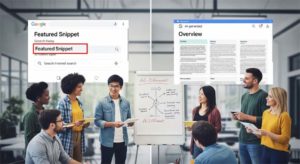 Those of you who are not new to search engine results pages (SERPs) might be wondering if AI Overviews are here to replace Featured Snippets. No, they are not. But how do these two coexist, then?
AI Overviews show up when Google thinks users need a mini explainer, not just a pull quote — an evolution that underscores the AI impact on SEO by rewarding more comprehensive, synthesised answers. They appear for questions that benefit from synthesis, i.e., collecting bits from several credible pages. Straightforward facts seldom trigger them.
Featured Snippets work differently. They’re often a direct lift from one source, formatted cleanly. They bring minimum ambiguity and are usually formatted as a single, crisp paragraph.
AI Overviews, on the contrary, write their connective tissue while citing multiple sources.
Use this lens to predict Overview triggers:
Those of you who are not new to search engine results pages (SERPs) might be wondering if AI Overviews are here to replace Featured Snippets. No, they are not. But how do these two coexist, then?
AI Overviews show up when Google thinks users need a mini explainer, not just a pull quote — an evolution that underscores the AI impact on SEO by rewarding more comprehensive, synthesised answers. They appear for questions that benefit from synthesis, i.e., collecting bits from several credible pages. Straightforward facts seldom trigger them.
Featured Snippets work differently. They’re often a direct lift from one source, formatted cleanly. They bring minimum ambiguity and are usually formatted as a single, crisp paragraph.
AI Overviews, on the contrary, write their connective tissue while citing multiple sources.
Use this lens to predict Overview triggers:
- “How do I…” searches with several steps or caveats.
- “What is…” plus “why it matters” style questions.
- Side-by-side comparisons that need more than a table.
- Situational advice (“best option if…”) with variables.
- Queries that have more than one likely answer.
How Google Sources and Synthesises Content for AI Overviews
Under the hood, Google’s AI Overviews are a retrieval-and-rewrite exercise. Google hunts for passages that collectively answer the query, then rewrites them into a single, coherent block. It isn’t trying to replace sources; it’s trying to compress them. Trust signals guide what gets pulled. Google is more likely to pull information from sources with strong authority and a network of topically relevant links pointing to their content. That link graph and reputation layer help the system filter noise from substance. Once sources are selected, the model looks for overlaps and gaps. If two pages say the same thing, it may merge the phrasing. If one adds a crucial warning that the others miss, it gets folded in. The goal is a rounded answer, not a direct quote. You’ll notice the tone is plain and neutral. That’s deliberate. The model avoids brand voice, loaded adjectives, and anything overly promotional. It aims for “useful explainer,” not “marketing pitch.”11 Ways to Optimise Your Content to Be Cited in AI Overviews
 The key question so far is how to optimise a website, specifically its content, to get featured in AI Overviews. That’s what we’ll aim to answer in full in a moment.
One point must be clarified upfront to avoid disappointing your expectations — even if you fulfil everything we’ll reveal below, you are not guaranteed a place in AI Overviews. Nevertheless, you’ll significantly increase your chances of getting into one.
Without further ado, below are 11 practical tactics you can implement without rebuilding your entire site:
The key question so far is how to optimise a website, specifically its content, to get featured in AI Overviews. That’s what we’ll aim to answer in full in a moment.
One point must be clarified upfront to avoid disappointing your expectations — even if you fulfil everything we’ll reveal below, you are not guaranteed a place in AI Overviews. Nevertheless, you’ll significantly increase your chances of getting into one.
Without further ado, below are 11 practical tactics you can implement without rebuilding your entire site: